


Original price was: $342.00.$95.99Current price is: $95.99.
- Friendly, efficient service, always online.
- Efficiency meets excellence in customer care.
- Quality You Can Trust
- Satisfaction Guaranteed

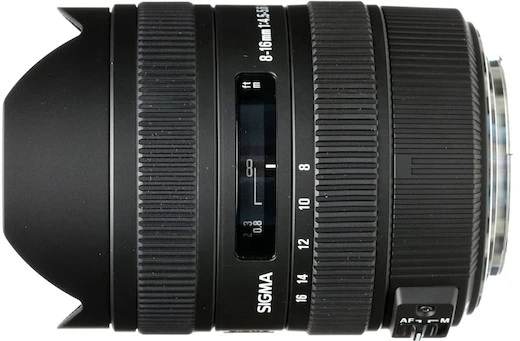
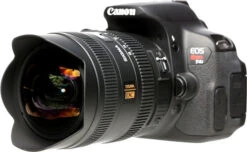
The Sigma 8-16mm f/4.5-5.6 DC HSM for Canon is an ultra-wide, rectilinear zoom lens for Canon crop-sensor cameras. Key features include:
-
Canon crop-sensor only
-
Produces striking, extremely wide-angle images
-
Excellent sharpness
-
Fast, smooth, and quiet autofocus with manual-focus override
It has an 8mm minimum focal length designed specifically for APS-C-size image sensors. The 114.5° to 75.7° angle of view produces striking, extremely wide-angle images with exaggerated perspective. It has an inner focusing system and 24-cm. minimum focusing distance throughout the entire zoom range.
Four “F” Low-Dispersion glass elements, which are equal in performance to fluorite glass, compensate for color aberration. One hybrid aspherical lens and two glass mold elements correct for distortion and astigmatism, while the Super Multi-Layer Coating minimizes lens flare and ghosting, helping to provide high color accuracy.
The lens’s Hyper Sonic Motor provides fast, smooth, and quiet operation in a wide variety of shooting situations. You can also manually override the autofocus motor at any time by rotating the focusing ring, giving you quick fine-tuning ability.
I was told this lens was just a remake of the old Sigma 12-24mm f/4-5.6 II for Canon for full frame cameras, but there’s more to it than that (although the big bulging front element will certainly …
I was told this lens was just a remake of the old Sigma for Canon for full frame cameras, but there’s more to it than that (although the big bulging front element will certainly remind you of it.)
First and foremost, let’s be clear: 8mm is significantly wider than 10mm, so I consider this lens somewhat different than the other ultra-wides. At 8mm you can get your shoes in the picture if you tilt the lens down just a bit. It’s wide.
It’s also quite sharp, especially in the center and at 8 to 10mm, which is probably what you’re getting this lens for anyway. More surprisingly, it doesn’t have horrible barrel distortion at 8mm, which is pretty amazing. At the longer end it’s not quite as sharp, and at any focal length the corners and even the edges are a little mushy. Chromatic aberration is pretty well controlled, too.
So I’m surprised: I expected to say it was a useful lens if you really want the widest you can get but that, otherwise, the lens had a lot of weaknesses (which is what I said years ago about the 12-24 full frame lens.) But really this one not only lets you get ultra, ultra wide, it can compete with all the other ultra wides from 10mm to 20mm too. It gives up some aperture to most of the others, but except for that, it’s very comparable to them.
And from 8mm to 10mm, well there’s no comparison at all. This isn’t the lens for everyone because many people will never shoot this wide, but if you think you might, this is a great choice and I can recommend it without reservation.
Comparisons
Comparing the ultra-wide, crop sensor camera lenses is an extremely difficult task, so I’ll put the summary first: they all deliver excellent image quality and you can’t go wrong with any of them. To my ‘just taking pictures’ assessment they are all excellent. There are some differences though, so I’ll try to point those out so you have a better chance at choosing the one that’s best for you.
is the widest (and remember, 8mm is 20% wider than 10mm, so it’s a very real difference). Not quite as sharp in the corners as the others, and lower maximum aperture, but it’s really pretty good, especially considering it’s the widest of the wide.
is arguably the most flare resistant, the smallest and lightest when that’s important, and has low distortion. It’s also the most expensive and vignettes a bit. I like it a lot, though, and often find myself preferring it because of its small size.
The Sigma 10-20 f/3.5 has a bit more distortion than the others but delivers very nice images and is also built much better than the Canon 10-22. It does everything well and probably is the best value of the bunch.
The Tamron 10-24 f/3.5-4.5 Di II is the least expensive of the bunch and has the longest zoom range. It actually has less barrel distortion than most of the others, but a bit more chromatic aberration (purple fringing) and perhaps a bit more vignetting. But none of these are severe and the larger zoom range often comes in handy.
gives you the widest aperture if you’ll be working in low light (with ultra wides, depth of field is rarely an important point), but it’s a bit soft at f/2.8, so the aperture advantage isn’t huge (I usually shoot it at f/4, if I can, to get it sharper). It has very little vignetting and distortion, probably the least of the group. Unfortunately, it does show quite a bit of chromatic aberration and is known to flare at times. But if you need f/2.8, this is your only choice, and it’s not a bad lens at all.
The Tokina 12-24 f/4 PRO DX II is built like a sturdy tank (and therefore a bit heavier). It does tend to give low contrast images when shot into the sun but is quite sharp otherwise. This is the one I’d take if conditions were rough: I pity the rock this bad boy falls on. Poor rock.
But like I said above: they’re all excellent. We hardly ever get anything but happy comments about any of them.
| Angle of View |
114.5° to 75.7° |
| Aperture |
f4.5-22 |
| Autofocus |
Autofocus |
| Brand |
Sigma |
| Compatibility |
Crop |
| Diameter |
3.0″ |
| Dimensions |
Length: 4.2″ |
| Filter Style |
Rear Gel |
| Flare Resistance |
Mild ghosting, mild to moderate loss of contrast |
| Focal Length |
8.0-16.0 |
| Focusing System |
Internal, A/MF switch, full-time manual, hypersonic motor |
| Groups/Elements |
11/15 |
| Hood Included |
Yes |
| Hood Type |
Built-in |
| Image Stabilization |
No |
| Item Type |
Lens |
| Lens Type |
Wide Angle |
| Low Dispersion Elements |
4 |
| Max Aperture |
4.5 |
| Maximum Magnification |
.13x |
| Minimum Aperture |
22.0 |
| Minimum Focusing Distance |
0.8feet |
| Mount |
Canon EF |
| System |
Canon |
| Weather Resistant |
No |
| Weight |
1.9 lb. |
| Zoom Method |
Barrel extending (slightly) |
Be the first to review “Sigma 8-16mm F/4.5-5.6 DC HSM For Canon”
Related products

Photo

Accessories
Flashes


Lenses
Reviews
There are no reviews yet.